It was a Tuesday afternoon in August, the kind where the air feels like a hairdryer pointed at your face, and I was standing in a villa in JVC staring at a DEWA bill for AED 4,800. One month. One family. The owner’s hand was shaking as he held the paper, and he looked at me and said, “Bhai, is this normal?” That single piece of paper taught me more about sustainable building UAE than any seminar ever could.
It was not normal. But it was not mysterious either. The villa was three years old, built with zero green thinking — big glass windows facing the afternoon sun, no shading, thin walls, an AC system running like it was trying to cool the Sahara. That bill changed how I think about every project I touch now.
People hear “green building” and picture solar panels and fancy certificates. Fair enough. But after twenty years on Dubai sites, I will tell you the truth: it is mostly common sense, tuned to this exact climate. The August heat. The September humidity that hits like a wet towel. The dust. The shamal winds. Design for those realities, and the eco-friendly part follows naturally.
Let me walk you through what actually works here — stuff I have seen with my own eyes, on real sites, with real clients’ money on the line.
The DEWA Bill That Changed How I Build

Back to that JVC villa. The family had moved in that summer, and their first full-month DEWA bill arrived like a slap. Almost all of it was air conditioning. The owner called me in a panic, thinking something was broken. Maybe a faulty meter.
Nothing was broken. The villa was just badly designed for where it sits. The master bedroom and the majlis had huge glass panels facing west — straight into the 4 PM sun, the most brutal hours of the day. Single-pane windows, no low-e coating, minimal wall insulation. The AC fought the full force of a Dubai afternoon every day, and it lost.
We sat with karak chai in their living room, and I did rough maths on a piece of paper. Proper external shading and better glazing on those two rooms alone would cut their cooling load by nearly a third. They were not wasting electricity through bad habits. The building was fighting the climate instead of working with it.
That day I made myself a promise: I will never hand a client a building that punishes them every month for the next twenty years. That is what sustainability means to me now. Not a plaque on the wall. A home that does not bankrupt you in August.
What Sustainable Building UAE Really Means in Practice
Forget the glossy brochures. In this country, it comes down to three questions I ask before a single drawing gets approved. First: how much heat gets in? Second: how much water gets wasted? Third: how much energy can we pull from the sky above us — because we have plenty of sky.
The official world has its own language. In Abu Dhabi you have the Estidama Pearl Rating System, mandatory for new buildings there and genuinely designed for our region — it scores energy, water, materials, and indoor air quality. In Dubai, LEED certification from the US Green Building Council is the name on every commercial tower, partly because tenants now ask for it.
But here is what nobody tells clients: you do not need a certificate to build smart. Some of the most efficient villas I have built never chased a rating at all. Get your architect and contractor in one room early, before the design is locked — that matters more than any badge.

Before You Spend a Dirham: Shade, Orientation, and the Envelope

My foreman Rashid has a saying: “The cheapest AC is the one you never have to buy.” In the UAE, cooling eats the biggest share of any building’s energy, and the smartest builders attack that with design, not machinery. Here is how.
Orientation. This costs nothing, and it is criminal how often it gets ignored. If your biggest glass faces east and west, you are inviting the sun into your living room. Turn the plan so the long faces dodge the worst sun, keep east-west exposures narrow, and put shaded courtyards in the middle. Old Emirati homes did this naturally with courtyards and wind towers. We just forgot.
Shade like you mean it. Mashrabiya-style screens, deep overhangs, louvers, vertical fins — proper shading that blocks harsh sun while letting daylight in. On a project in Al Barsha last year, we added fixed aluminium louvers to the west-facing rooms. The client’s cooling bills dropped 25% in the first summer. And good shading looks beautiful — it gives a building character instead of a glass box sweating in the sun.
Get the envelope right. At 45 degrees outside, your walls and windows are all that stands between your family and that AED 4,800 bill. Insulated cavity walls, double-glazed or low-e glass, properly sealed joints. On a site walk in Arabian Ranches once, I felt warm air streaming through a window gap you could slide a dirham coin through. Seal your envelope.
Let the air move when it can. From November to March, this city is a paradise. Courtyards, cross-ventilation, operable windows in the right places — during the mild months, natural airflow takes real load off the AC. I learned on a scorching July pour that this climate does not forgive bad planning.
Solar: The Obvious Move We Finally Stopped Ignoring
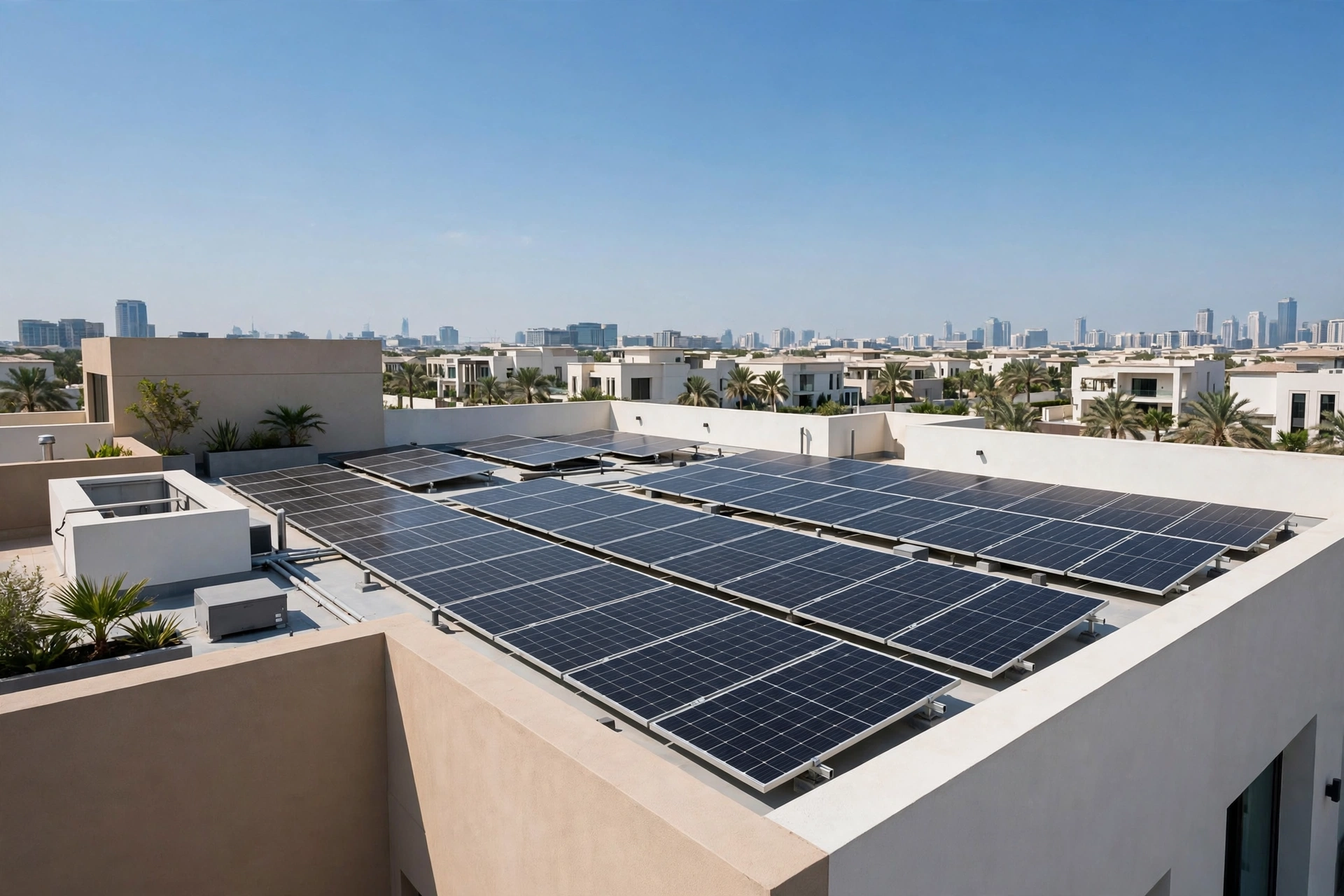
For years I joked that we were one of the sunniest places on earth and the slowest to use it. That is finally changing. Panel costs have fallen, regulations caught up, and rooftop solar now makes plain financial sense for villas and low-rise buildings.
The maths is simple. Net metering lets you feed surplus power back into the grid, which shrinks the payback period fast. And here is the beautiful part: panels produce maximum power at exactly the time your AC works hardest — midday. A match made in the desert.
On a villa in Mirdif, we installed a modest rooftop system last year. The family went from summer DEWA bills around AED 2,200 to under AED 900. Payback in about five years; panels warrantied for twenty-five. I just wish we had done it during construction — retrofitting always costs more than building it in from day one.
Do not overlook solar water heating either. Simple rooftop thermal collectors handle your hot water with barely any electricity. Old technology, proven for decades, quietly doing its job while you get on with your life.
Water Is Gold Out Here — Treat It Like It

Almost every drop of drinking water in the UAE comes from desalination, which is enormously energy-intensive. So remember this: saving water here is also saving energy. Two wins for one effort.
Start with the easy wins. Modern low-flow taps, showerheads, and dual-flush toilets cut consumption hugely without making you feel like you are camping. Upgrade fixtures first — it is cheap, fast, and the savings show on the very next bill.
Then there is greywater recycling: water from sinks and showers, treated on-site, reused for flushing or irrigation. Not glamorous, but on a commercial project near Dubai Investments Park it cut municipal water demand by nearly 40%. The client thought I was exaggerating until the quarterly bills arrived.
Landscaping is the other silent killer. Those lush lawns around some villas? Each drinks like a small swimming pool. I push every client toward drip irrigation, native and drought-tolerant planting, and controllers that check the weather before watering. A well-designed native garden looks more striking than a struggling patch of grass anyway.
My favourite trick is AC condensate recovery. In our humid months, air conditioners produce litres of water daily — pure condensate dripping off the coils. Most buildings let it pour down a drain. Collect it and you have free irrigation water from thin air. A client in Dubai Silicon Oasis now waters his entire garden on recovered condensate. Free water, made by the humidity we all complain about.
The Payoff Nobody Puts in the Brochure

People always ask: “Does all this cost more?” Yes and no. Some features add upfront cost, but the most effective strategies — orientation, shading, a tight envelope — cost almost nothing extra when designed in from day one. They only become expensive when you fix them afterward.
I saw this on a villa where fixing a problem late taught us an expensive lesson — retrofitting is always the painful option, whether it is a crack or an energy disaster. Build it right the first time and the savings compound: lower bills, less maintenance, longer-lasting equipment.
There is also the market angle. Tenants and buyers increasingly ask about running costs. A commercial building with a green rating is not just a lobby plaque — it is a leasing argument. A villa with documented low DEWA bills sells faster and holds value better. I have watched it happen.
And a quieter payoff: low-VOC paints and proper ventilation make the indoor environment genuinely healthier. When the mosque azan drifts across the site at Maghrib and my crew pauses for a minute, I think about the families who will live in what we built. A healthy home is part of the job, not a bonus.
The UAE’s sustainability ambitions are real, and regulations will keep tightening. Eco-friendly construction is on a one-way trip from differentiator to default. If you are planning something — a villa, a commercial space, anything — talk to a contractor who knows this climate before the design is finished, not after. It helps to know what to look for when choosing that contractor — and you can reach out to our team to talk it through.
Frequently Asked Questions
What is sustainable building in the UAE, in simple terms?
Sustainable building in the UAE means designing for our extreme heat, humidity, and water scarcity — through smart orientation, shading, insulation, solar power, and water-saving systems. The goal is a building that stays comfortable while using far less electricity and water than a conventional one.
Is it more expensive to build a sustainable villa in Dubai?
It can add some upfront cost, but the most effective strategies — proper orientation, shading, and a sealed insulated envelope — cost very little extra when designed in from day one. The real expense comes from retrofitting later, and most clients recover the investment through lower DEWA bills within a few years.
Do I need LEED or Estidama certification for my villa?
No, certification is optional for private villas. Estidama’s Pearl Rating is mandatory for new buildings in Abu Dhabi, while LEED is common on Dubai commercial projects. Many efficient villas never chase a certificate — they simply get the fundamentals right. Certification is most valuable for commercial buildings where tenants actively look for it.
How much can solar panels reduce a DEWA bill in Dubai?
A typical villa rooftop system can cut summer DEWA bills by 40 to 60%. Net metering lets you feed surplus power back to the grid, which shortens the payback period — usually around five years, with panels warrantied for twenty-five.
What is the single most effective sustainable feature for a UAE home?
Passive design: getting the orientation, shading, and building envelope right before anything else. Blocking heat from entering is far cheaper and more effective than cooling it out afterward. A well-shaded, well-insulated villa can reduce cooling demand by a quarter or more with no running cost at all.
How does water saving relate to energy saving in the UAE?
Almost all potable water here comes from desalination, which uses enormous amounts of energy. Every litre saved through low-flow fixtures, greywater recycling, or drip irrigation also saves the energy used to desalinate it. In the UAE, water conservation is energy conservation.