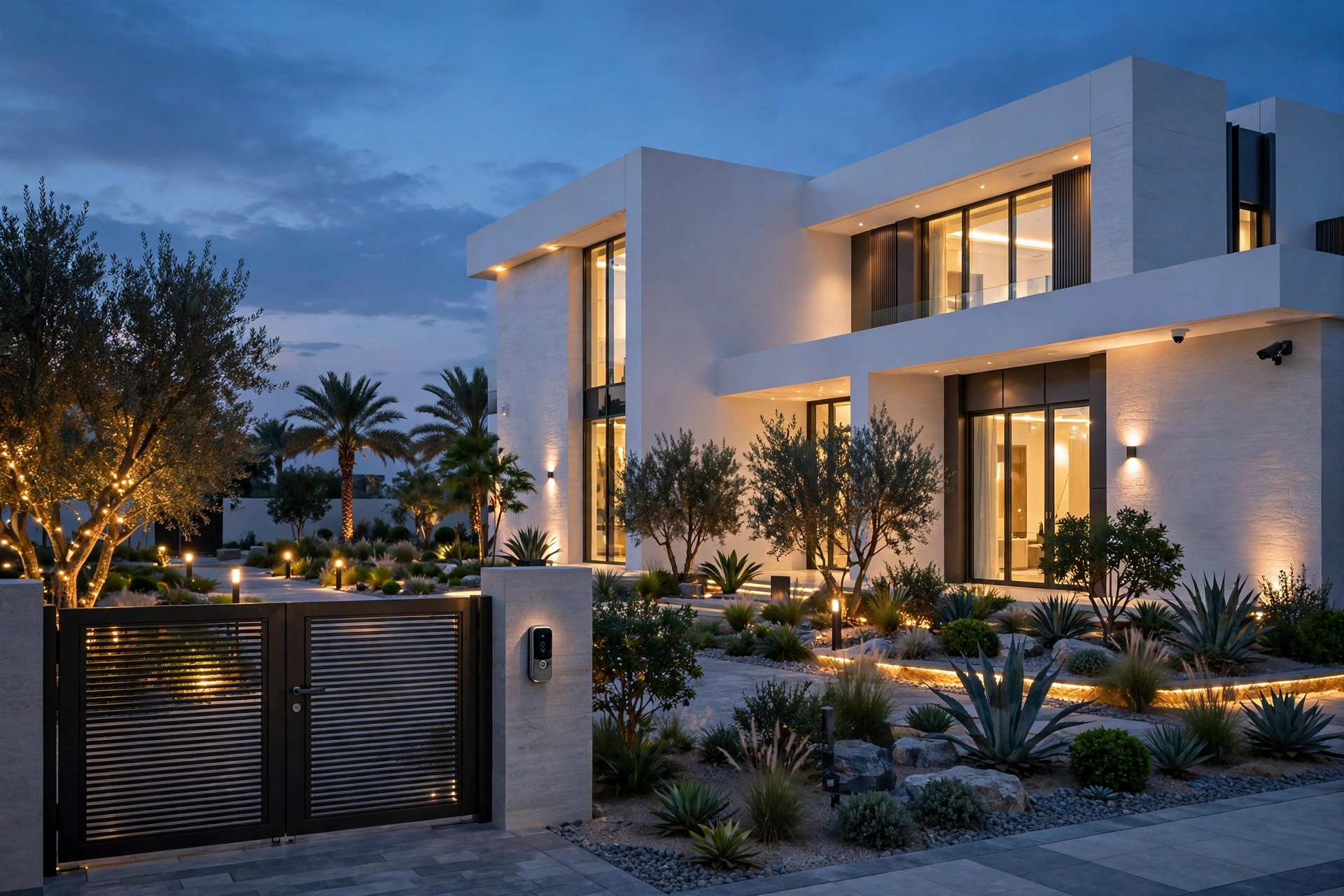
Last August I watched a villa gate in Arabian Ranches swing open by itself as the owner turned into the driveway — no guard, no remote. The garden lights woke up, and the majlis AC had been running for twenty minutes, the whole place at twenty-four degrees while it was forty-seven outside. No magic in it — only smart home technology UAE builders like me wire into new villas every month, and the real trick is planning it before the walls close up.
Most people learn one thing too late: a smart home is not a shopping list. The smartest villa I ever worked on had fewer devices than the dumbest one — but every cable and conduit had been thought about months earlier, when the house was still lines on paper.
Why Smart Home Technology in the UAE Starts With the Heat

Everything about smart home technology UAE planning begins with one enemy: the August monster. Forty-eight degrees in the shade, air thick with dust, and your DEWA bill climbing like it is trying to escape the country.
Cooling is the hungriest mouth in any villa. I have seen bills in JVC where the AC alone ate more than half the monthly total — four bedrooms cooled all afternoon for nobody. That is where automation earns its keep: a smart thermostat that cools only the rooms in use, pre-cools the house before you return from work, and talks to an occupancy sensor so the guest room is not sitting at twenty-two degrees while your guests are abroad. Not luxury features. Survival features.
The hardware has to survive too. A client in Business Bay once showed me the bargain video doorbell he had bought online — it lasted one summer. By September the plastic had warped and the button stuck like chewing gum. Outdoor cameras, gate controllers, intercom panels: all of it bakes on a wall at fifty degrees while shamal dust sandpapers it for months. We pour concrete through that same heat, and concrete pours at 50 degrees in Dubai taught us respect for what this climate does to materials. Properly rated gear costs more on day one and pays for itself by not dying in year one.
Then there is the dust nobody talks about. Fine desert dust creeps into sensors and camera housings, so outdoor devices need proper ingress ratings, not promises on a box. A camera tucked under a deep eave lasts twice as long as one on a sun-facing wall.
The Cheapest Smart Home Is Planned Before the Plaster

I say this to every client, sometimes twice: the cheapest smart home is the one planned before the walls go up. Once the plaster is on, every new cable becomes its own little construction project — we once opened a finished Marina ceiling for a single network cable, and the repair cost more than the cable.
So at the design table, before a single block is laid, here is the groundwork I insist on. First, empty conduits to every room: from one central ventilated cabinet to each bedroom, the living areas, the roof, the gate, and the garden. You do not need to fill them on day one — but three years from now, when you want a camera on the side wall, the pathway is already waiting in the wall.
Second, neutral wires at every switch — missed in nine out of ten standard plans and painful to fix later, since many smart switches need one. Third, one proper home for everything: router, network switch, automation controller, CCTV recorder, all labelled in one cabinet with room to grow. Nothing kills future servicing faster than a system nobody can reach.
Fourth, power and data at the edges — gate, rooftop, garden — where doorbells, CCTV, landscape lighting, and irrigation live. Running those cables while the site is open costs almost nothing; retrofitting later means cutting driveways and digging up new landscaping. Raise this at the design meeting, not after the drawings are done — and a detailed villa construction cost breakdown for 2026 shows exactly where this small early investment sits against everything else.
Home Automation Essentials: Five Systems, Not Fifty Gadgets
Walk into any electronics shop and they will sell you fifty gadgets. You need about five systems. Climate control comes first, always, in this country: smart thermostats that learn your schedule and talk to occupancy sensors, with zoned cooling so each bedroom has its own control — the empty study sits at twenty-eight degrees instead of twenty-two, sipping electricity instead of gulping it.
Lighting comes second: scenes for morning, evening, and night; motion sensors in corridors and bathrooms so nobody fumbles for switches at 3 a.m.; dimmable LEDs everywhere.
Motorized blinds are the most underrated system in the whole smart home. Modern UAE villas are glass — floor-to-ceiling glass facing west, because the architect wanted drama. Afternoon sun turns those living rooms into greenhouses, and blinds that close automatically during peak heat take real load off the AC.
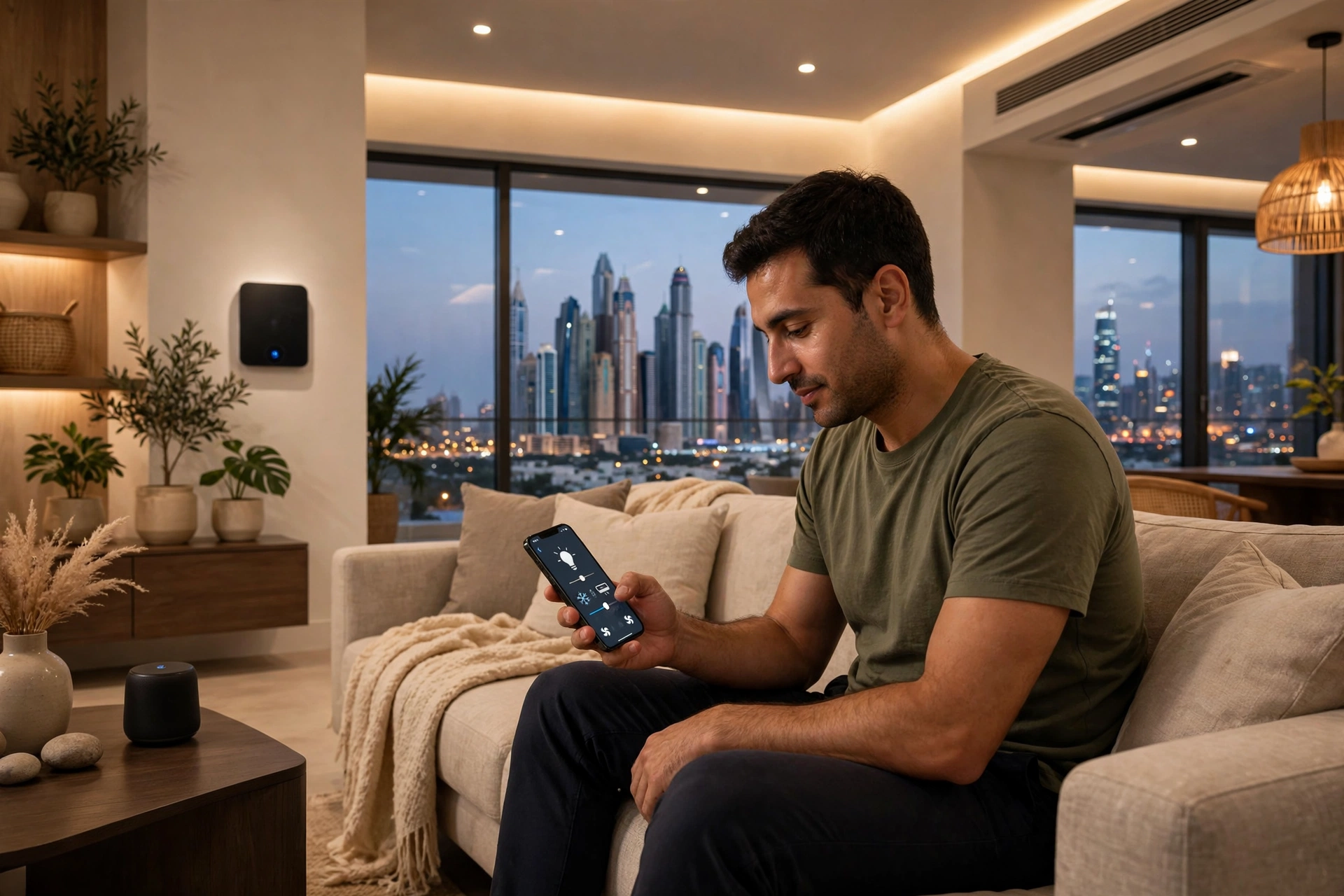
Then the glue: one app to rule them all. Voice or app control tying every system together — that is the moment devices become an actual smart home. Pick devices that play well together, or you will end up with six apps and a headache. Open standards beat closed ecosystems; that shiny proprietary system might be abandoned in three years.
Energy Management: Making the DEWA Bill Behave

A small energy monitor on your main panel is one of the most eye-opening devices you can own. The first week is always a comedy of horrors: the pool pump running at noon, an AC fighting a balcony door left open, standby loads quietly adding up overnight. Once you can see it, you can fix it.
Smart systems can shift heavy loads — water heaters, pool pumps, the washing machine — to cheaper hours or, with rooftop solar, to when your panels are producing most. Solar is spreading across UAE villas fast, and the house that runs its hungriest appliances while the sun pays for them is the house with the smallest bill.
Water deserves the same intelligence. I have lost count of the villas where I have seen sprinklers running in the rain — that classic Dubai sight of a garden being watered while the sky does the job for free. Smart irrigation that reads the weather keeps the landscaping alive without the waste.
Security That Works When the Wi-Fi Doesn’t

Security is what gets most people into smart home tech: video doorbells so you can see who is at the gate from your office in DIFC; CCTV on entrances, perimeter, and garage with local storage; smart locks with keypad or fingerprint entry plus temporary codes for guests and staff.
Then the unglamorous heroes: door and window sensors, smoke detectors, water-leak sensors under sinks and near the water heater. Cheap, boring, and they have saved villas from serious water damage. One caught a washing machine hose at 2 a.m. — the owner woke up to a text message instead of a flooded floor.
One hard rule, and I do not bend on it: anything protecting your home must keep working when the internet does not. Locks must open with a code when the router is down. Alarms must sound when the Wi-Fi drops. If your security dies with the internet, it is decoration, not security.
Retrofitting an Older Villa: Very Doable, If You Phase It
Most of my smart-home calls are for villas five, ten, fifteen years old — solid houses whose owners want modern brains. Lean on wireless: modern systems handle lighting, sensors, and thermostats with no chasing walls. But upgrade your network first — a mesh Wi-Fi system is the foundation of everything. Weak network, flaky smart home.
Start where it counts: bedrooms and living areas, where automated climate and lighting pay off fastest. Do those first, live with them a month, then expand. Check the electrical panel too — older panels sometimes have no room left for the extra breakers, and a quick assessment by an electrician tells you where you stand before you spend a dirham.
Phase it deliberately: security first, then climate, then the nice-to-haves. Living with phase one teaches you what you really want from phase two. The same thinking applies to bigger changes on an older villa — our home renovation guide for Dubai covers where to start and what to avoid: plan the bones before you buy the finishes.
Choosing Partners: The Fault Line Where Projects Go Wrong
Smart home work sits exactly on the fault line between three trades: electrical, IT, and finishing. It is precisely where projects go wrong, because each trade assumes the other one handled it. The electrician ran the cables but not the network; the IT guy configured the app but never talked to the electrician; the gypsum contractor sealed the ceiling over the controller nobody can reach.
This is why the team matters more than the brand of thermostat. You need a contractor who gets the electrician, the network guy, and the finishing crew at the same table before work starts, not after it goes wrong. On products, my advice never changes: open standards, established lines, and always ask who supports this locally. A device with no local support in the UAE is a future paperweight.
If you are planning a build or a major renovation, have the automation conversation at the design table — early decisions determine just how smart your home can become. And if you want a builder who thinks about wiring before the walls go up, talk to us before your drawings are finished — it is the cheapest meeting you will ever have.
Frequently Asked Questions
How much does smart home technology cost for a villa in the UAE?
For a typical 4–5 bedroom villa, a solid essentials package — zoned climate control, smart lighting, motorized blinds, video doorbell, CCTV, and smart locks — usually lands between AED 25,000 and AED 60,000 when planned during construction. Retrofitting later can cost 30–50% more in labour, while the pre-wiring itself is only a few thousand dirhams with walls open.
Can I add smart home technology to an older villa without breaking walls?
Yes, for most systems. Modern wireless devices handle lighting, thermostats, sensors, locks, and cameras without chasing walls — the main prerequisite is a strong mesh Wi-Fi network. The exceptions are motorized blinds, which need power at the window head, and gate or garden devices, where running new cable through finished landscaping is the hard part.
Will smart home devices survive Dubai’s summer heat?
Only if they are rated for it. Outdoor gear should handle at least 50°C with proper dust and water ingress protection — cheap uncertified cameras and doorbells routinely fail after a single August. Mount them in shade where possible, and confirm local warranty and spare parts in the UAE before buying.
Does a smart home keep working during a Wi-Fi or internet outage?
It should, if designed properly. Locks, alarms, lighting scenes, and local camera recording must run on local control, not cloud servers. Ask your installer exactly what happens when the internet drops — anything critical that stops without Wi-Fi is a design flaw. Remote phone access will pause, but the house must keep functioning.
Should I plan smart home wiring before or after the villa design is finished?
Before — during the design stage itself. Conduit routes, the equipment cabinet, neutral wiring, and power points at the gate and garden all belong in the drawings, not in later variations. Raising automation at the design table costs almost nothing; adding it after plastering means cutting open finished work.
Do smart homes actually reduce DEWA bills in the UAE?
Yes, measurably — mostly through climate control. Zoned cooling, occupancy-based setbacks, and automated blinds typically cut cooling energy by 20–35% in a family villa, and cooling is the largest slice of most DEWA bills. Pairing automation with rooftop solar pushes savings further.