The first time I watched a home renovation in Dubai die on a Tuesday morning, nobody picked up a tool after 10 a.m. It was Al Barsha, late summer, the kind of August heat that makes the air shimmer over parked cars.
The demolition crew arrived at seven with sledgehammers — the client’s new apartment was getting gutted that week. By ten, community security had rolled up with a clipboard and zero sense of humour. No NOC. Nobody had applied for one.
Security ordered everyone off the floor, and three days later a fine landed: a little over AED 5,000, plus the cost of an idle crew while we scrambled the paperwork the job should have started with. The renovation still happened and turned out beautifully, but the client paid for two things that week — the fine, and the lesson.
I have been building and renovating in Dubai for over a decade, from Business Bay towers to Arabian Ranches villas, and I can tell you: the difference between a renovation you love and one you complain about for years is almost never money. It is planning. Here is the walkthrough I wish every client read first.
The NOC Nobody Warned You About
If you take one thing from this article, take this: you generally cannot start renovation work in Dubai without permission, and the permission has a name you will hear a hundred times — the NOC, the No Objection Certificate.
Most master communities — Emaar, Nakheel, Dubai Properties, DAMAC, Meraas — require an NOC before you touch anything beyond light decoration. You submit your scope of work, sometimes drawings, pay a fee, and often put down a refundable security deposit until inspections pass. For a typical apartment, expect a fee of roughly AED 2,000 to AED 5,000 and a deposit of AED 5,000 to AED 15,000; villa jobs in Arabian Ranches or JVC can carry bigger deposits.
Then there is building management, its own kingdom. In a Business Bay or Marina tower, the facility team controls working hours, noise limits, corridor protection, and booking the service elevator for materials. One missed booking and your tiles sit in a loading dock while the crew bills you by the day.
For the heavy stuff — moving structural walls, extending a villa, significantly altering plumbing or electrical systems — Dubai Municipality permits enter the picture, and those can take weeks. A competent contractor will tell you on day one which side of that line your job sits on. A straightforward NOC might clear in days; a villa job with drawings can take two to four weeks, so put approval time on the calendar like a phase of work.
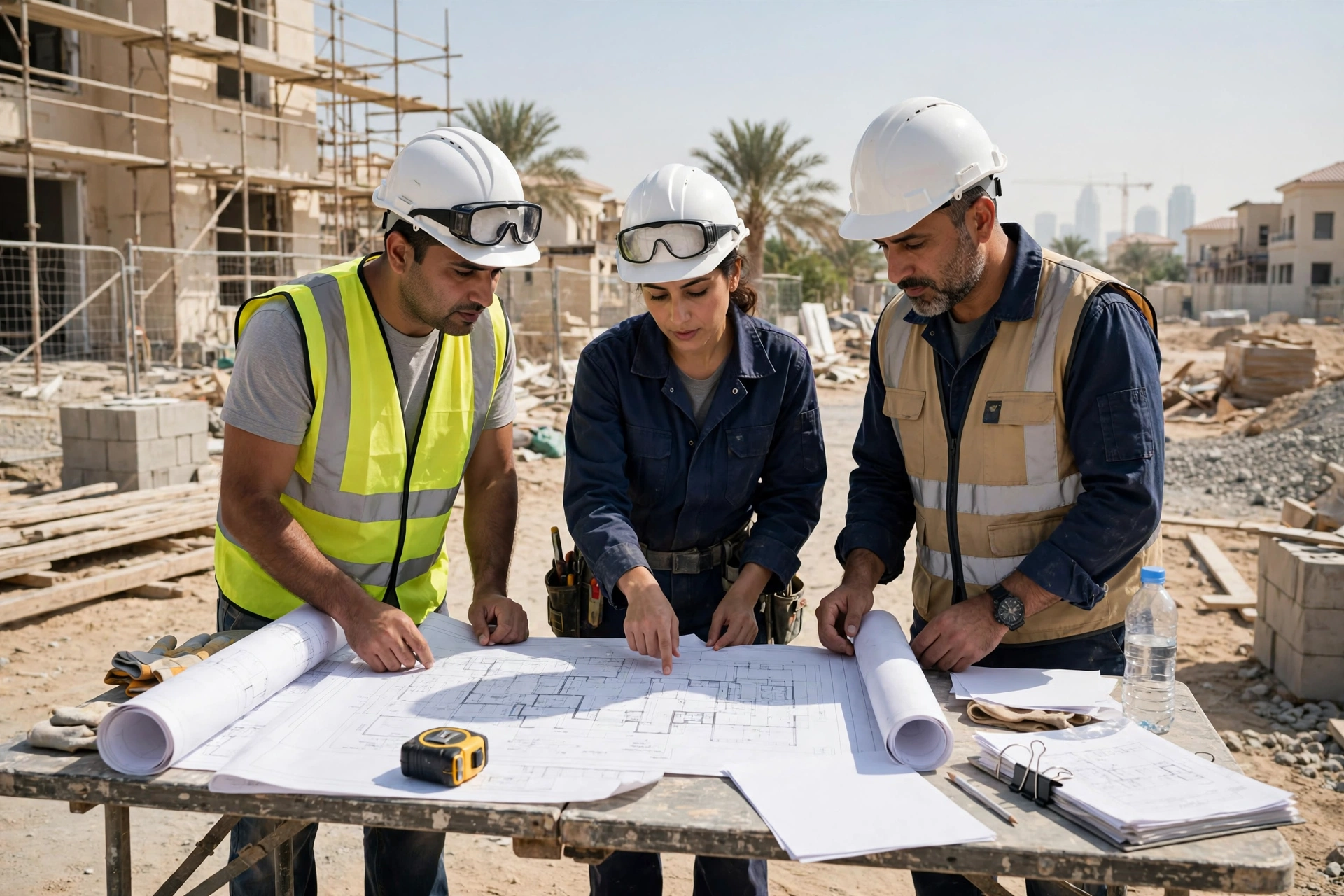
Start With a Scope, Not a Shopping List

The second most common mistake I see, and showrooms are to blame: a client falls in love with imported Italian porcelain at AED 90 a square metre before knowing what they are doing, and the whole project reorganises itself around that tile. The tile becomes the budget.
Do it the other way around. Before anything else, write — on paper — what you want to change and why. Which rooms are in, and which are out? Are you moving walls, doors, and plumbing points, or just refreshing finishes?
Be honest about the goal, too: everyday comfort, resale value, rental appeal, or simply making the place feel like yours? A villa owner in Arabian Ranches once told me over karak chai she just wanted her kitchen to stop feeling like a corridor she cooked in. That one sentence saved her about AED 40,000 — once the goal was comfort and light, not a designer showpiece, we could scope honestly.
A written scope does two quiet jobs that pay for themselves. It makes quotes comparable — every contractor prices the same work, so the numbers mean something — and it fights scope creep, that slow expansion where a “two-week job” becomes a two-month job because someone said “while you’re at it, let’s also redo the guest bathroom.”
Budgeting a Home Renovation in Dubai — Honestly, Then Add the Buffer

Nobody can give you a single number because the range is enormous, but here are the ranges I actually see: a full bathroom renovation typically runs AED 15,000 to AED 35,000. A kitchen redo — cabinets, countertops, plumbing points — usually lands between AED 30,000 and AED 80,000. A full villa refresh across several rooms can go from AED 150,000 to AED 400,000 and beyond.
Build the budget in three layers: the work itself; the stuff nobody puts on a mood board (NOC fees, deposits, inspection charges, service elevator deposits, debris removal); and a contingency of 10 to 15 percent, held in reserve. Not “if” you need it — when. Every renovation uncovers something: a plumbing surprise, a material price jump, a detail nobody thought of.
Get at least three detailed, written quotes — line by line, not voice notes over the phone. And a truth I tell every client: a dramatically low quote is not a bargain, it is scope someone quietly left out, and you will meet it later when it costs twice as much to fix. I wrote about exactly that in our story about the renovation that nearly broke us — the cheap quote, the skipped approvals, the bill that caught up anyway.
One more budget habit: finalise your number before you collect quotes, not after. If the quotes set your budget, the budget is just the quotes wearing a trench coat.
Pick Your Contractor Like You’d Pick a Surgeon
You would not choose a surgeon on price alone, and you should not choose a contractor that way either.
Start with the trade licence — anyone doing contracting or fit-out work in Dubai should hold a valid one, and asking to see it takes thirty seconds and filters out a surprising number of problems. Then match their experience to your job: a contractor brilliant at villa extensions in Dubai Hills might be the wrong pick for an apartment bathroom in JLT. Ask to see finished work that looks like yours.
Insist on a written contract: scope, materials with brands and specs where it matters, a payment schedule, start and finish dates, warranty terms. If it is not written down, it does not exist. Tie payments to milestones — a modest advance, then payments as stages complete, with a final retention held back until snagging is done. Be very cautious about anyone who wants most of the money upfront — that is your money doing the travelling.
Once work starts, agree on one contact and a weekly rhythm — a short message with a few site photos. It keeps everyone honest and creates a paper trail. For the full checklist, here are the ten essential checks I tell every client to run before hiring a construction company in Dubai.
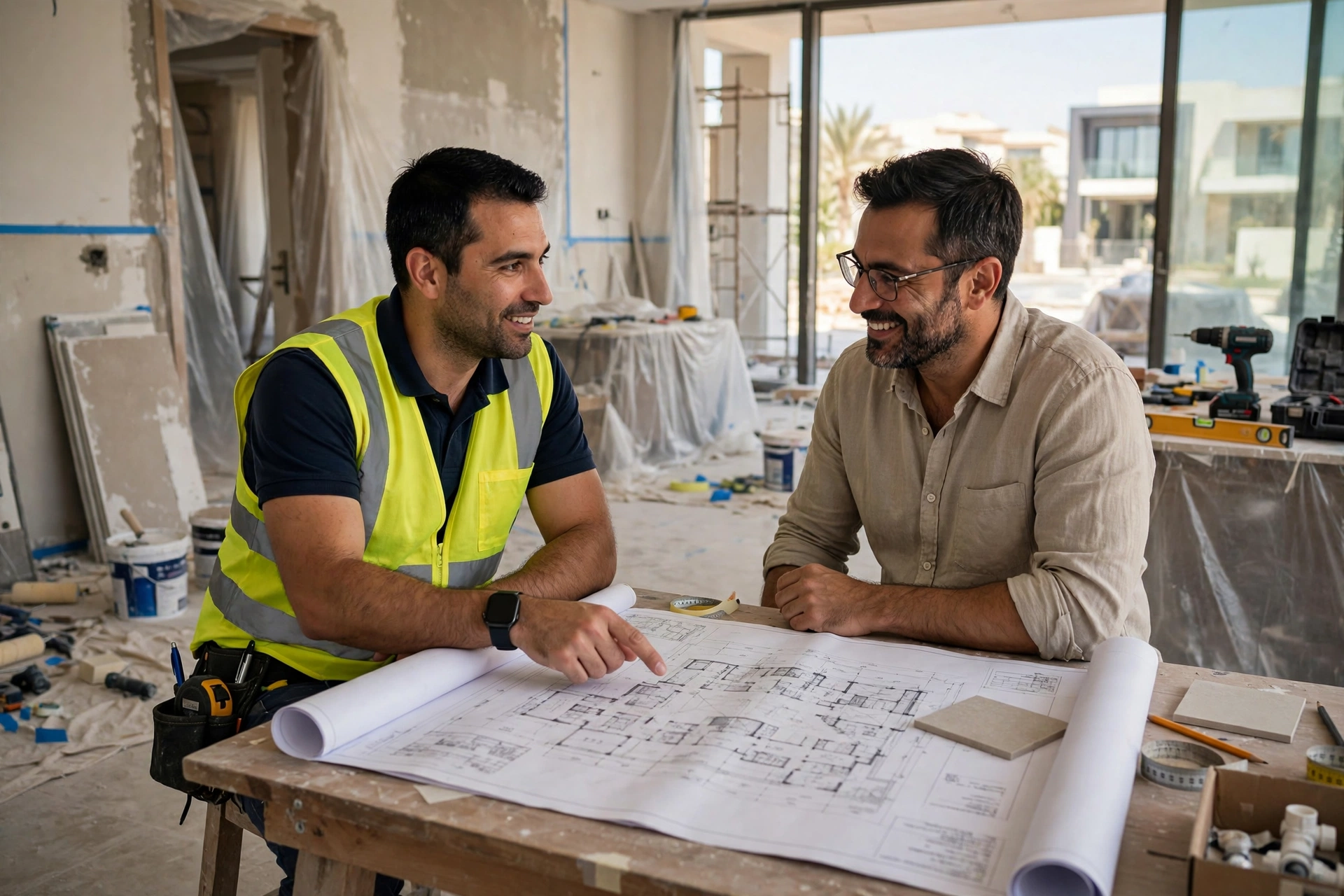
The Order of Work — and Why Fighting It Gets Expensive

The sequence is almost always the same: approvals, demolition, structural and MEP rough-in (plumbing, electrical, AC ducting), waterproofing where needed, tiling and flooring, carpentry and joinery, painting, fixtures and final finishes, then deep clean and snagging.
This order exists because each layer hides the one beneath it: rough-in plumbing goes behind the tiles, tiles go under the paint line, cabinets get measured against finished walls. Do things out of order — paint before tiling is the classic — and you end up doing them twice. A client in a JVC apartment painted before the new floor tiles were laid, and the tilers scuffed every wall within a week. That is what out-of-order work costs: the same labour, paid for twice.
Waterproofing deserves its own mention: in this climate, a bathroom membrane is the difference between a renovation that lasts fifteen years and one that grows a damp patch by year two. It is invisible when it works and catastrophic when it does not.
If you are living in the place during the work, sequence it so at least one bathroom and a basic kitchen stay usable for as long as possible — dust travels further than you think, and sealing work zones is worth every dirham. Confirm working hours with building management before anyone complains: neighbour complaints turn into fines with remarkable speed.
The Mistakes I See Every Single Year

Skipping approvals. Starting without the NOC can mean stop-work orders, fines, and ripping out finished work. The shortcut is never worth it.
Choosing on price alone. The cheapest quote has a habit of becoming the most expensive project once variations and rework arrive.
Changing your mind mid-stream. Every change order costs time and money and scrambles the sequence, so finalise tiles, sanitary ware, paint colours, and fixtures before work starts, not during.
Waving through the snag list. Before the final payment, walk the finished work slowly and list every defect, however tiny — a wobbly handle, a grout gap, a paint drip. A good contractor fixes snag items without drama; once you have paid in full, your leverage is gone. And keep access panels reachable: a boxed-in bathtub looks great until a pipe leaks behind it and the only way in is a sledgehammer.
Treating ventilation and lighting as afterthoughts. In this climate, ventilation prevents real moisture damage, and layered lighting changes how a space feels more than almost any finish. Plan both early.
Renovation is messy, dusty, occasionally maddening work. But it comes down to this: successful renovations are rarely about spending the most — they are about clear planning, honest numbers, proper approvals, and people you trust. Get the foundations right and everything downstream gets dramatically easier.
If you are standing where my Al Barsha client stood that Tuesday morning — full of ideas, unsure of the first step — write your scope, then talk to a qualified, licensed contractor who can walk you through approvals and give you a realistic picture of cost and timeline. One good consultation can save months of frustration, and that is exactly what our renovation team does every week across Dubai.
Frequently Asked Questions
Do I really need an NOC for a small renovation in Dubai?
In most cases, yes — especially in master communities like Emaar, Nakheel, or DAMAC, and in towers where building management runs its own fit-out process. Anything touching tiles, plumbing, electricals, or structure needs approvals, so check with your community and building management before starting.
How long does a typical home renovation in Dubai take?
A bathroom usually takes two to four weeks of work, a kitchen three to six weeks, and a full villa two to four months. Add approval time on top — straightforward NOCs take a few days, villa jobs with drawings two to four weeks — and always budget calendar time for approvals, not just work time.
How much does a home renovation cost in Dubai?
As rough ranges: a full bathroom runs AED 15,000 to AED 35,000, a kitchen AED 30,000 to AED 80,000, and a full villa refresh AED 150,000 to AED 400,000 or more. Set aside 10 to 15 percent as contingency, and budget separately for NOC fees and refundable deposits.
Can I live in the house while the renovation is happening?
You can for smaller jobs — sequence the work so at least one bathroom and a basic kitchen stay usable for as long as possible, and seal work zones against dust. For bigger jobs, many homeowners find it simpler, and often cheaper overall, to move out temporarily rather than live on a construction site for weeks.
How do I choose a reliable contractor for a home renovation in Dubai?
Check their trade licence, match their experience to your job type, and insist on a written contract covering scope, materials, payments, dates, and warranty. Tie payments to milestones with a final retention held until snagging is complete, and be very cautious of anyone asking for most of the money upfront.