Drive down any street in Al Barsha at golden hour and you can read villa facade design Dubai owners got right like a language. The stone-clad villa that still looks sharp after ten summers. The painted one that has faded to a sad beige on its sun-facing wall. The one wrapped in cheap composite panels that are already warping at the corners like a paperback left in the sun. Your facade is the first thing anyone sees and the last thing you should cheap out on, because in this city the sun, the dust, and the humidity run a brutal quality-control test on every exterior, every single day.
A facade is not decoration. It is the villa’s skin, and it has to do three jobs at once: look expensive, survive the climate, and satisfy the people with clipboards at Dubai Municipality and your community developer. This guide covers how to get all three right, with real costs and the mistakes I keep seeing repeated.
The Three Styles That Actually Work Here
Dubai villas fall into three broad facade families, and each one sends a different message.
Modern minimalist is the current default for new builds: clean lines, flat roofs, big glass panels, white or warm-grey render with one accent material like wood-effect screening or dark aluminum. Done well it looks timeless. Done badly it looks like every third villa on the street, which is the risk. If you go modern, the detailing has to be perfect, because there is no ornament to hide behind. Crisp shadow lines, flush windows, and one material used with restraint.
Classic Arabic is the style with arches, mashrabiya screens, cornices, and warm stone tones. It never goes out of fashion here because it belongs here. The trick is proportion. Real Arabic architecture has a logic to it: shaded openings, screens that filter light, massing that steps back from the street. A villa with two token arches glued onto a modern box looks confused. If you want classic, commit to it properly or hire a designer who understands the grammar.
Transitional is what most smart owners actually build: a modern villa with Arabic touches. A mashrabiya screen over the entrance, stone cladding on the ground floor, clean lines above. This is the sweet spot for resale too, because it photographs modern but feels rooted. I have watched transitional villas sell faster than pure-style ones in the same community, because they appeal to both local and expat buyers.
Cladding Materials: What Survives and What Surrenders
Paint is the cheapest finish and the most honest one, because it shows every flaw in the workmanship underneath. On a well-rendered wall, a high-quality exterior acrylic paint in a light color is a perfectly good facade. Budget roughly AED 60 to 120 per square meter for a proper job with primer and two coats. The catch is maintenance. In Dubai’s UV, even good paint wants a refresh every five to seven years, and dark colors fade visibly within three. I once watched an owner repaint his charcoal-grey villa three times in eight years. The paint was fine. The color choice was the problem.
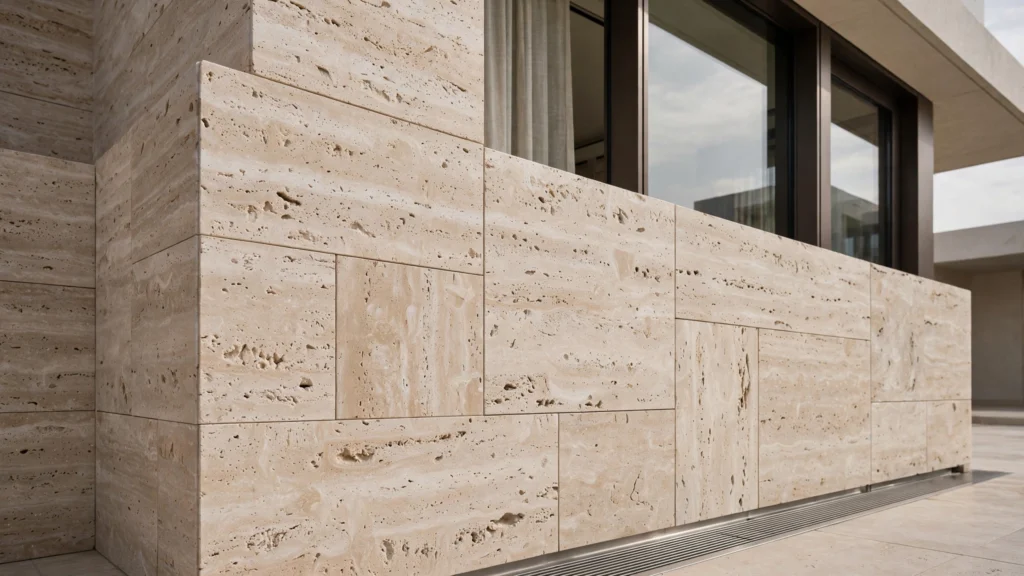
Natural stone is the premium answer and it earns it. Travertine, limestone, and sandstone cladding laugh at the sun and look better with age. A stone facade tells every visitor exactly what the villa cost before they reach the door. Real numbers: supply and installation of natural stone cladding runs AED 350 to 700 per square meter depending on the stone and the fixing system. It is heavy, so the structure has to be designed for it, and the fixing system matters enormously. Stone that is glued on instead of mechanically fixed will eventually let go. I have seen it happen, and it is not a small repair.
HPL (high-pressure laminate) panels are the modern workhorse: thin, light, available in wood effects, stone effects, and solid colors, with excellent UV resistance if you buy the exterior grade. This is the material behind most of those crisp modern facades. Cost: AED 250 to 450 per square meter installed, including the aluminum subframe. The subframe is non-negotiable. Panels need a ventilated cavity behind them so heat and moisture can escape. The failures I see are always the same story: someone screwed panels directly onto the wall to save the subframe cost, and two summers later the panels are buckling.
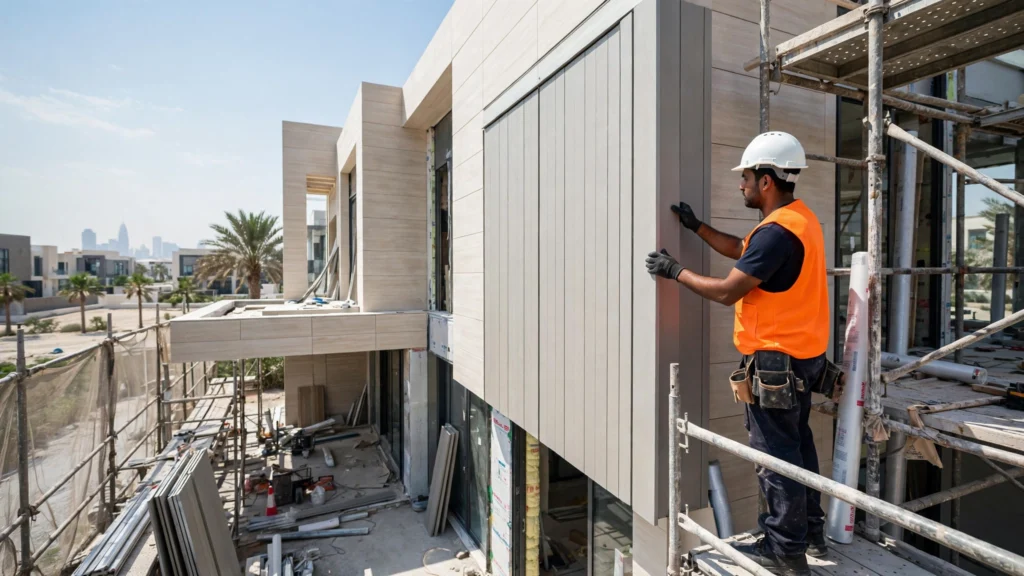
Aluminum composite panels (ACP) are cheaper than HPL and common on commercial buildings, but use them carefully on a villa. The budget grades chalk and delaminate in this climate. If you use ACP, insist on a reputable brand with a proper PVDF coating and a fire rating certificate. Dubai Municipality is strict about facade fire safety after the high-rise fires of past years, and combustible cladding on a villa will fail inspection. Budget AED 180 to 320 per square meter installed for decent quality.
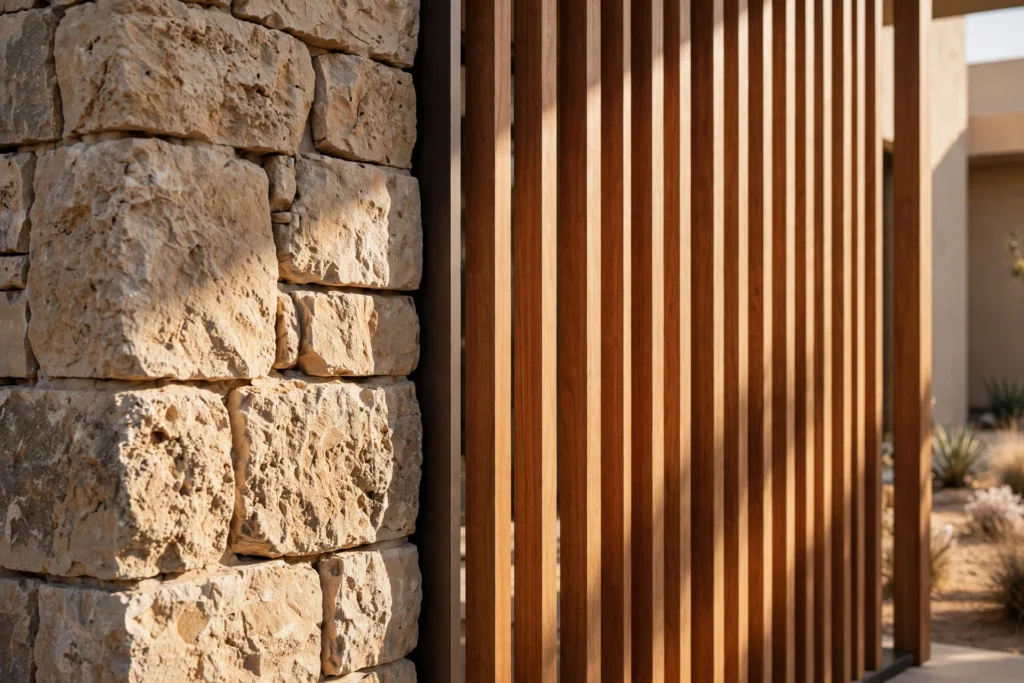
Wood and wood-effect screens are for accents, not full coverage. Real timber in this sun needs oiling every year or it goes grey and splits. Most owners are happier with aluminum screens in a wood-effect powder coating: they look like timber from three meters away and need nothing but a wash. Mashrabiya-style screens over windows and entrances do double duty, cutting solar gain while looking unmistakably Arabic. Budget AED 400 to 800 per square meter for quality laser-cut aluminum screens.
Textured paint and plaster finishes sit between plain paint and stone: acrylic texture coats, stone-effect plasters, and exposed aggregate finishes. They hide minor wall imperfections and add depth that flat paint cannot. AED 90 to 180 per square meter. A good middle path for owners who want more than paint but cannot stretch to stone.
The Approvals Nobody Tells You About Until It Is Too Late
Here is the part that surprises owners. In most Dubai communities, you cannot just change your facade. The villa’s exterior appearance is controlled twice over.
Dubai Municipality cares about structure, fire safety, and setbacks. If your facade work is cosmetic, recladding within the existing building line with non-combustible materials, you are usually fine. But if the new facade changes the building’s footprint, adds projections, or alters the structure, you need a permit. Anything structural goes through a licensed contractor with drawings.
Your community developer cares about how the street looks. Emaar, Nakheel, DAMAC, and the others all have design guidelines, and most require a no-objection certificate before you touch the facade. The NOC process typically takes two to four weeks and costs a few hundred to a couple of thousand dirhams depending on the community. Developers are particular about colors, materials, and anything visible from the street. I have seen NOC applications rejected for a shade of beige that was deemed “not in keeping with the community palette.” Start the NOC before you order materials, not after.
One more tripwire: if your villa is in a community with a strict design code, the original developer’s approved material palette may be your only legal option. Check before you fall in love with a stone that the community will never approve.
Lighting the Facade at Night
A facade designed only for daylight is half a design. Dubai villas live at night, and the right lighting turns a good facade into a landmark.
Uplights at the base of stone or textured walls create drama for very little money. Small LED spike lights in the planting bed, aimed up, cost AED 150 to 300 each installed. Wall washers under the roofline give an even glow across the elevation. Backlit mashrabiya screens are the showstopper: light behind a screen throws patterned shadows across the wall and the driveway, and it costs less than people expect because the screen was already in the design.
Keep it warm. 2700K to 3000K, always. Cool white light on a villa facade looks like a petrol station. And put the facade lighting on a timer or an astronomical switch so it comes on at dusk by itself. Nobody wants another app to open.
Budget AED 5,000 to 15,000 for a proper facade lighting scheme on a typical villa, including fixtures, wiring, and the timer. It is the cheapest wow-per-dirham in the entire project.
What It Costs, Honestly
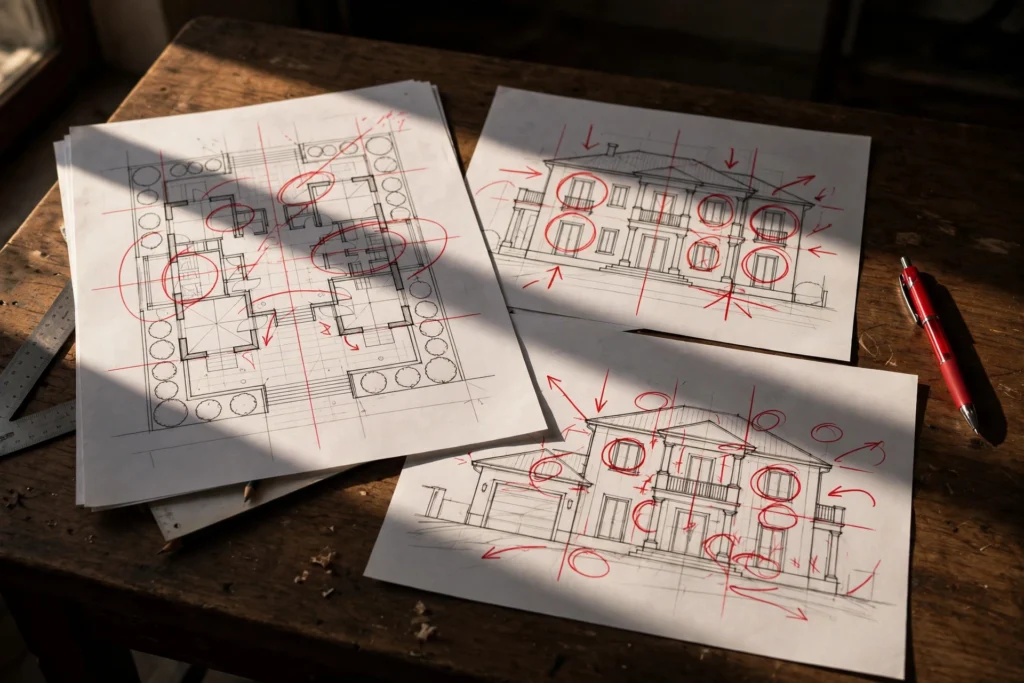
For a typical villa with roughly 300 square meters of facade area, here are realistic all-in ranges I see on real projects.
A quality repaint with minor render repairs: AED 18,000 to 35,000. A textured plaster finish: AED 30,000 to 55,000. HPL panel cladding on the feature elevations with paint elsewhere: AED 60,000 to 120,000. Full natural stone cladding: AED 120,000 to 220,000. Add facade lighting on top: AED 5,000 to 15,000. Add the developer NOC fees and any engineering: AED 2,000 to 8,000.
These are supply-and-install numbers from decent contractors, not the cheapest quote and not the palace builder. Get the quote itemized by material and area. “Complete facade, AED 80,000” tells you nothing.
Mistakes That Ruin Facades
I will keep this short because each of these has cost someone I know real money. Dark colors on sun-facing walls. They fade, they show every dust film, and they make the wall hotter, which ages everything faster. If you must go dark, keep it to shaded elevations or small accents. Cheap cladding with no subframe. Panels screwed flat to the wall will warp. The ventilated cavity is not optional. Skipping the NOC. Starting facade work without the developer’s approval can get your site sealed and your new cladding ordered for removal. Ignoring the dust. Dubai’s dust settles on everything. Smooth, light-colored surfaces wash clean with a hose. Deep textures and dark colors show every film. Design for the maintenance you will actually do, which for most people is a hose twice a year. Forgetting the night. A facade with no lighting plan looks unfinished half its life.
The Elevation That Earns Its Keep
A good facade does quiet work for decades. It keeps the heat out, it shrugs off the dust, it makes the villa worth more the day you sell, and it makes you smile every time you turn into your street. Spend the money where the sun hits hardest: the materials, the fixing system, and the approvals. The paint color you can change in a weekend. The cladding system you live with for twenty years. Choose like it.