Step onto a villa roof in Dubai at one o’clock on an August afternoon and you will understand, in about four seconds, why roof insulation Dubai homeowners keep postponing ends up costing them every single summer. The concrete burns straight through your shoes. The air above the surface shimmers like water. And somewhere below you, the air conditioner is running at full blast, losing a fight it was never built to win.
Most people blame their AC when the top floor stays warm. They service it, regas it, sometimes replace the whole unit, and the bedrooms still feel like a parked car at four in the afternoon. The unit was never the problem. The problem is six inches of bare concrete between your family and a sun that takes no days off.
This guide covers what actually works on Dubai roofs: the materials worth your money, real costs per square metre, what proper installation looks like, and what it does to your DEWA bill.
Why the Roof Matters More Than the Walls
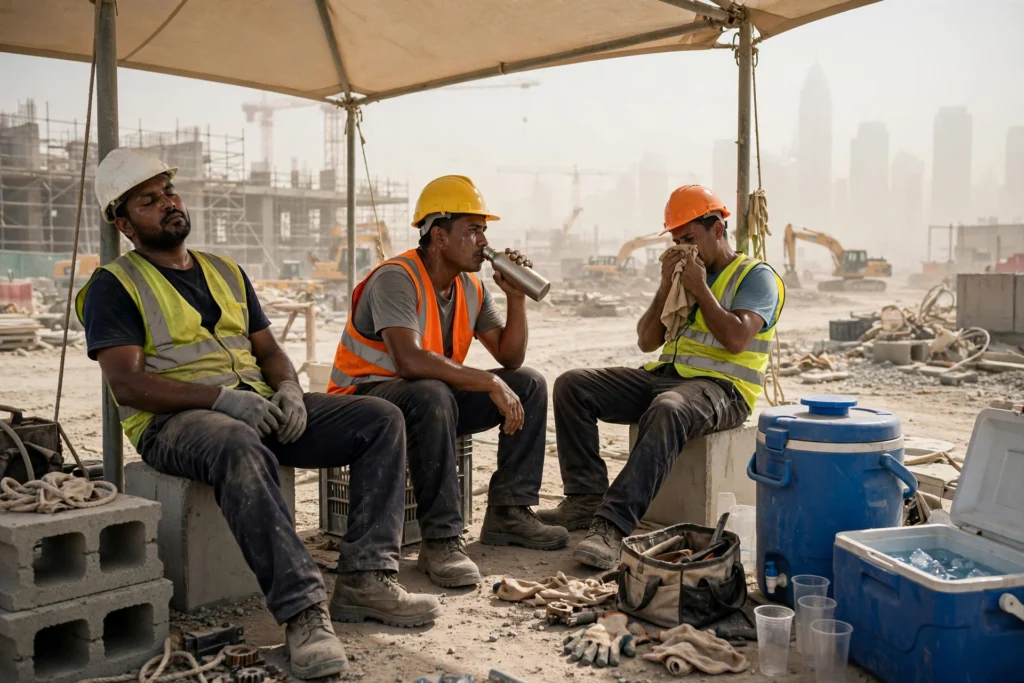
Your roof takes more punishment than every wall in the house combined. Walls get shade and the sun hits them at an angle; half the day they face away entirely. The roof takes the full blast, straight down, for ten to twelve hours, when the air is already 45 degrees.
A bare concrete slab in July can hit 70 degrees on its surface. Dense concrete does not just get hot, it stores heat like a battery and keeps releasing it into your ceilings long after sunset. That is why upstairs bedrooms feel warm at midnight. The slab is still paying out the heat it collected at noon.
You can feel which villas are insulated without anyone telling you. In an uninsulated house, the staircase becomes a boundary between two climates. Good roof insulation erases that line.
How Heat Actually Travels Through a Concrete Roof
You do not need an engineering degree here, but the basic picture helps you judge every sales pitch. Heat moves through your roof in two ways that matter.
First, conduction. The sun heats the top surface and that heat conducts straight down through the slab into your ceiling. In this climate, concrete is a good conductor of exactly what you do not want.
Second, stored heat. The thick slab soaks up energy all day and radiates it downward all night. This is why painting the roof white, while helpful, never fully solves it alone. You treat the surface symptom while the slab keeps up its slow nightly release.
Real insulation breaks both paths: it slows daytime conduction and keeps the slab cooler so there is less stored heat at night. Any contractor who cannot explain this plainly is selling a product, not a solution.
The Materials That Actually Work Here
Dubai’s climate kills delicate solutions. Whatever goes on your roof must survive brutal UV, winter downpours, and maintenance crews’ foot traffic. These are the materials proven on local roofs, with honest numbers.
Spray polyurethane foam
This is the workhorse of Dubai roof insulation. Sprayed on as a liquid, it expands into a seamless blanket with no joints for heat to sneak through, and it doubles as a second waterproofing layer, which matters on older roofs.
The catch is the sun. Raw foam degrades under UV, so it needs a protective elastomeric topcoat, recoated every few years. A contractor who quotes foam without mentioning the topcoat is inexperienced or hoping you will not ask.
Typical cost: AED 60 to 90 per square metre for 50mm thickness, including the protective coating.
XPS boards
Extruded polystyrene boards are rigid panels laid over the waterproofing membrane, then covered with screed or tiles. They handle foot traffic well, making them right for roofs you actually walk on: terraces, areas around AC units, anywhere the maintenance guy goes.
Boards have joints, so installation quality matters enormously. Gaps become highways for heat. A good crew staggers joints like brickwork and tapes the seams.
Typical cost: AED 45 to 70 per square metre, before the protective screed or tiles on top.
PIR boards
Polyisocyanurate boards look like XPS but pack more insulating power per inch, usually with a foil face reflecting radiant heat. When parapet height limits your buildup thickness, PIR earns its keep. It costs more and forgives standing water less, so slope and drainage must be right first.
Typical cost: AED 55 to 80 per square metre.
Reflective roof coatings
These white or silver coatings reflect sunlight before it becomes heat in the slab. As a standalone fix they are the cheapest option, and on a tight budget they genuinely help.
But coatings are paint, not insulation. They cut surface temperature dramatically, yet do nothing about heat that still gets through. They chalk and thin out, so budget for a recoat every three to five years. A good supporting actor, not the lead.
Typical cost: AED 25 to 45 per square metre for a proper two-coat system with primer.
Lightweight insulating screed
Perlite or vermiculite in a lightweight screed gives insulation and roof slope in one pour. On older villas with ponding, where water sits in puddles instead of draining, this creates falls toward the drains and insulates at the same time.
It is heavier than foam and needs a competent crew. A bad one leaves you with a lumpy roof that still ponds.
Typical cost: AED 70 to 110 per square metre, depending on average thickness.
What a Proper Installation Looks Like
The material is only half the job. I have stood on roofs with premium boards installed so badly they might as well have been cardboard, and on roofs with basic materials laid by a careful crew that performed beautifully.
Watch for four things while the work happens. First, slope: water must run to the drains, because where water ponds, insulation fails early and waterproofing soon after. Second, continuity: insulation should run unbroken across the roof and turn up at the parapets, since heat loves an edge. A roof insulated in the middle with bare strips around the edges is a jacket with no zipper.
Third, protection: foam gets its UV coating the same week it is sprayed, and boards get their screed or tiles before the crew leaves. Fourth, drains stay clear. I have seen crews neatly bury roof drains under screed. Check every drain yourself before paying the final invoice.
In Dubai you will usually see the inverted buildup: membrane directly on the slab, insulation above it, then tiles or gravel on top. This shields the membrane from sun and foot traffic, which is why it lasts. If a contractor proposes insulation under the membrane on a new roof, ask why, and listen carefully.

What It Does to Your DEWA Bill
Insulating the roof will not halve your whole DEWA bill, anyone who promises that is lying, but the effect upstairs is dramatic and measurable.
For a typical villa, the upstairs cooling load drops roughly 20 to 35 percent. In dirhams: with a summer bill around AED 2,500 a month and half of that cooling the upper floor, savings run AED 400 to 700 a month through peak months, or AED 3,000 to 5,000 a year.
Against a job costing AED 15,000 to 30,000 for an average villa roof, payback lands at roughly two to four years. After that the savings are pure profit every summer. And that counts only money, not sleeping through August nights without the AC screaming.
The Rules You Cannot Ignore
Dubai Municipality’s Al Sa’fat green building regulations set maximum heat-transfer values for new roofs. For villas the assembly typically needs a U-value around 0.57 W/m²K or better, so your consultant calculates the required thickness and the municipality checks it at permit stage.
If you are building new, ask to see the calculation so you know what thickness is going in. If you are retrofitting, nobody checks, but the regulation is the government’s way of saying this is the minimum that makes engineering sense. Do at least that much.
Mistakes That Waste Your Money
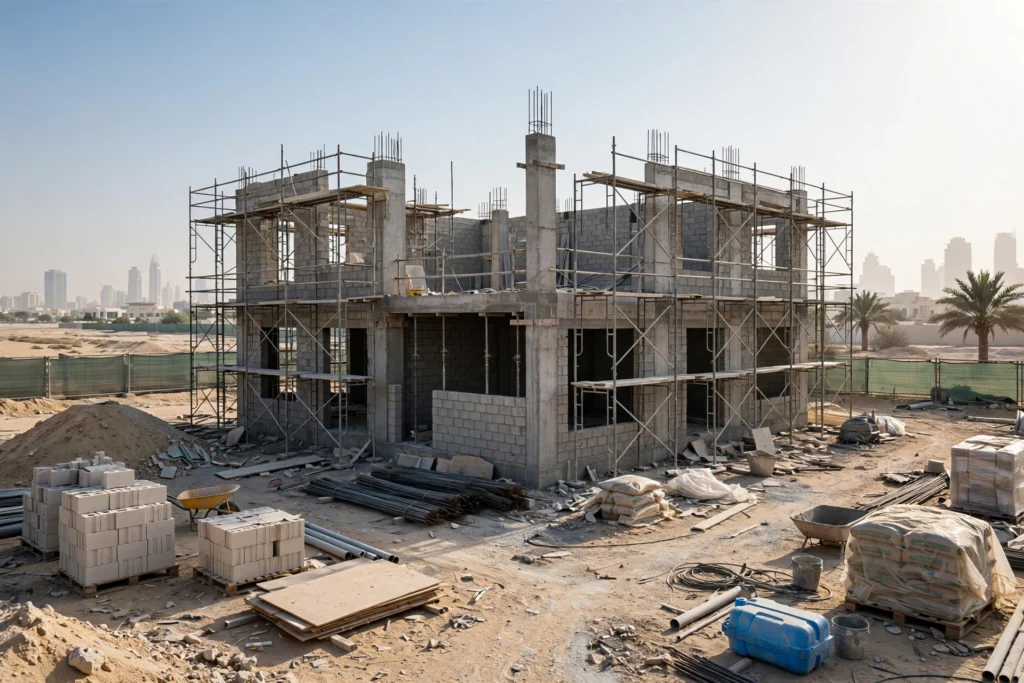
The most expensive insulation is the kind you pay for twice. These are the failures I see repeated across Dubai.
Insulating over a ponding roof. Fix drainage first or do both together. Insulation in permanent puddles compresses or delaminates, and then you own an expensive sponge.
Skipping the parapet. Heat flanks around your new insulation through bare parapet walls. Insulate the parapet faces or accept a permanent weak spot.
No UV protection on spray foam. I have seen foam turn to yellow dust in eighteen months because the topcoat was coming next week. It never came.
Choosing purely on price. The cheapest quote gets there by thinning the material, skipping slope correction, or vanishing before the warranty matters. On roofs, the middle quote with local references is usually cheapest in the end.
Choosing Someone to Do the Work
Ask for three things before anyone touches your roof. First, the material and thickness in writing on the quotation. Not “insulation work” but “50mm spray polyurethane foam with elastomeric topcoat” or “50mm XPS boards with staggered joints under 40mm screed.”
Second, a warranty covering insulation performance and waterproofing integrity for at least five years. Third, addresses of two roofs they did over two years ago. A proud contractor gives this without blinking. One who hems and haws is telling you everything.
The Roof You Never Think About Again
Good roof insulation is unnoticeable within a week. No hum, no blinking light, no app. What you notice is absence: no wall of heat on the staircase, no AC running all night, no DEWA bill that makes you wince in September.
In a city where the sun is the one neighbor you cannot negotiate with, that quiet absence is worth every dirham.